
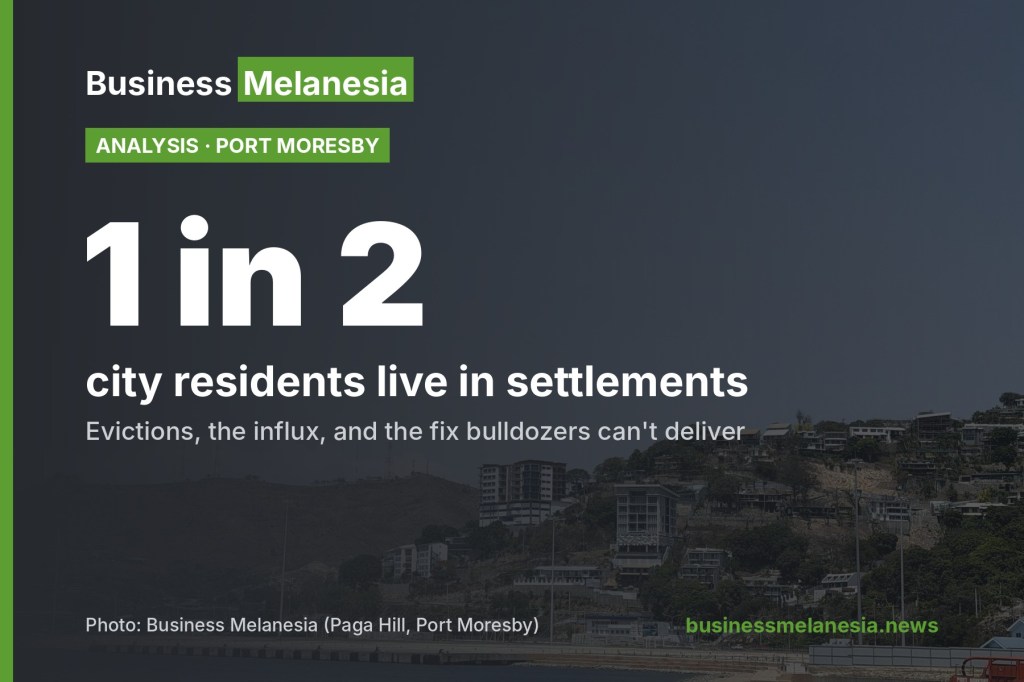
PORT MORESBY — Every eviction in Port Moresby ends the same way. The bulldozers leave, the land goes quiet, and the families who lived there move a few kilometres down the road into another settlement. The problem does not disappear. It relocates.
This has been a year of evictions in the capital. In January and February, police and bulldozers cleared Two-Mile Hill after what Governor Powes Parkop called repeated crime and violence the community had failed to stop. Police said officers were attacked with machetes. An Australian National University analysis of drone images later counted at least 150 homes destroyed, and estimated that about 1,200 former residents were left without a home.
Court orders have since hung over settlements at Tete and the Erima Wildlife area, and the National Court stepped in to stay an eviction at Four-Mile. “It is best that you leave, or the machines will move you out,” police commander Benjamin Turi warned settlers in March.
Prime Minister James Marape has tried to slow things down. In February he apologised to families facing “duress”, and pledged more than K20 million for land mapping and 5,000 to 7,000 planned residential blocks at Six Mile and Nine Mile. In May he asked title holders to show “consideration for humanity” and announced a temporary halt to some evictions. The Government has since spoken of more than 10,000 new blocks for the capital.
Land will not run away — but people’s lives are directly affected.
James Marape, Prime Minister
The case for clearing
The argument for evictions is real, and many city residents make it strongly. Landowners and title holders have rights, often won in court years ago. Some settlements have become hideouts for criminals, and businesses in nearby suburbs pay heavily for guards, fences and lost stock. Unplanned shacks block roads, power lines and water projects, and they scare off the investors the capital needs. “We do not want Port Moresby to become a city of unplanned settlements,” the Prime Minister said in February. On that, most leaders agree.
The cost of clearing
The other side is just as real. More than half of Port Moresby’s people live in informal settlements, according to the ANU research. They include the security guards, cleaners, drivers, market sellers and shop workers the city runs on. When a settlement is cleared without somewhere else to go, children leave school, workers lose jobs, and innocent families pay for the crimes of a few. Researchers found evicted families mostly move deeper into the city, not home to their provinces, so crowding gets worse elsewhere.
Why people keep coming
The bigger question is why so many leave home in the first place. The answer starts in the provinces. In too many districts, schools lack teachers, health centres lack medicine, and there are few jobs or markets for what people grow. District development money that should fix this is too often poorly spent or never properly accounted for. Tribal fighting has driven whole families from their land in parts of the Highlands. The wantok system, a great strength in hard times, also means one relative in the city becomes a landing place for many. And some come chasing the idea of easy money in town, only to find there are 3,000 job seekers queuing for a few hundred jobs, as happened when a new supermarket opened at Eight-Mile.
Our take
Unplanned settlements cannot be the future of our capital. But evictions alone treat the symptom, not the disease. Port Moresby, Lae and Madang will keep filling up until life at home in the provinces is worth staying for.
That means each province backing a few commodities it can sell to the world, such as coffee in the Highlands, cocoa and vanilla in the Sepik and the islands, and fish along the coast, with roads, buyers and credit to match. Our Highlands coffee cooperatives earned K6.5 million in three months by organising themselves. Multiply that across the provinces and fewer young people will need a bus fare to Port Moresby.
It also means leaders spending district funds on schools and clinics, not on themselves, and publishing where the money goes. In the city, evictions should come with somewhere to go: serviced blocks people can buy or rent over time, and police targeting criminals rather than whole communities. And every one of us has a part to play. Education, hard work and a change in attitude, from the village to Waigani, will do more than any bulldozer.
What to watch: whether Tuesday’s Budget funds the new residential blocks and provincial agriculture, and whether the Government’s promised national plan for settlements finally arrives.
Image: Business Melanesia. Background photo: Paga Hill, Port Moresby. Photo: Business Melanesia.



Leave a Reply