
GOROKA — For four decades, coffee farmers in the hills of Obura-Wonenara sold their parchment to whoever turned up at the roadside with cash. This year they tried something different. They formed cooperatives, milled their own green bean, had it graded in Goroka and sold it straight to exporters. The money followed.
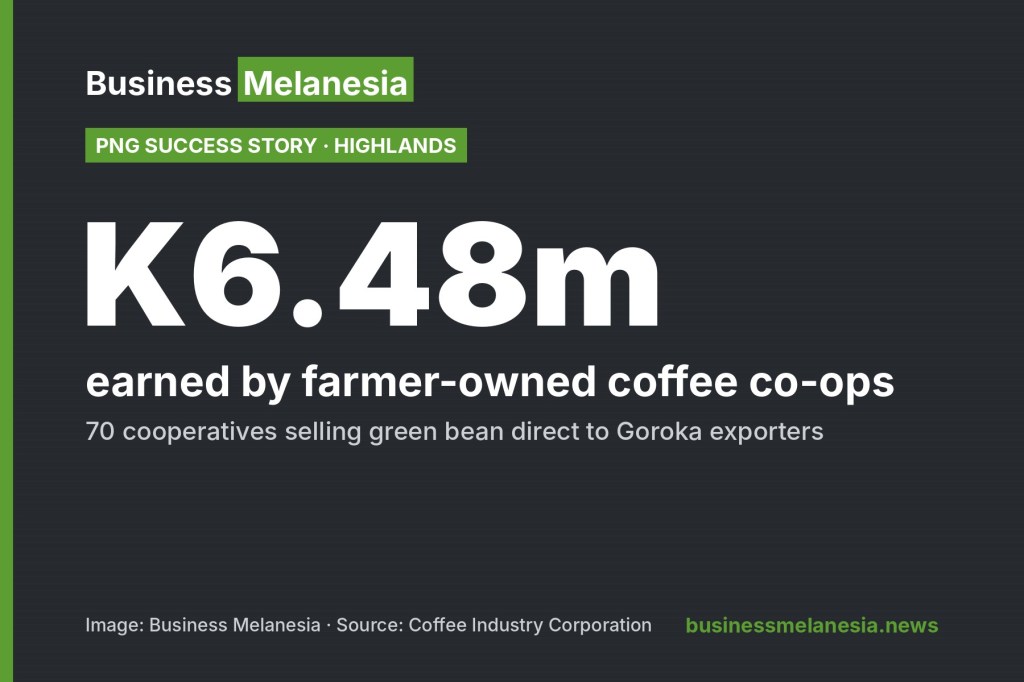
Under the Coffee Industry Corporation’s “coffee cooperative crusade”, 70 farmer-owned cooperatives in Eastern Highlands, Chimbu and Morobe had sold more than K6.48 million worth of coffee by the end of July, starting from nothing on May 1. The figures come from the programme’s manager, Potaisa Hombunaka, as reported by The National.
Trucks, not handouts
Lamari Coffee Cooperative Society in Obura-Wonenara earned about K490,000 from its first four sales after it began selling together in July. Its neighbour, the Amokara Coffee Cooperative at Barabuna village, has earned more than K714,000. Members put part of that into four second-hand trucks, so they now have their own transport to the mills and exporters in Goroka.
The crusade grew out of the World Bank-supported PNG Agriculture Commercialisation and Diversification (PACD) project, run through the Department of Agriculture and Livestock. The project closed on June 30, but the cooperatives kept selling, because they belong to the farmers. There are now 150 registered, with almost 27,000 members.
The money they are receiving is from the same coffee they have always grown.
Potaisa Hombunaka, PACD coffee component manager
What changed
The trees stayed the same. The selling changed. Farmers now process their coffee to green bean, have it cup-tested at the CICL quality laboratory, and negotiate as a group. “Now farmers have a reference point,” Mr Hombunaka said, according to The National. Women are taking seats on cooperative executives, and families are spending the income on solar power, school fees, transport and replanting.
The idea is spreading beyond coffee. In Morobe, the Finschhafen Cocoa Cooperative, which says it represents more than 15,000 smallholder growers, was formally recognised this month by the cooperative societies division of the Department of Commerce and Industry. It plans to move into processing.
Why it worked
Three things made the difference. Scale gives bargaining power: a cooperative delivering more than 170 bags at a time is a customer an exporter wants to keep. Quality data gives confidence: a laboratory grade turns a haggle into a negotiation. And ownership gives staying power. Because members own the cooperatives, they kept going when the donor money stopped, which is the point where many PNG agriculture projects have faded.
The lesson reaches well beyond coffee. PNG’s goal of three million bags a year will not come from seedlings alone. It will come from farmers who are paid enough to look after their trees. What matters now is support after the project ends: roads that stay open to Goroka, bank and agriculture-credit finance for trucks and pulperies, and good governance so that cooperative money stays clean.
What to watch: whether new cooperatives keep registering ahead of the 2027 harvest, and whether Tuesday’s Budget sets aside money for follow-up support.
Know a business success story from PNG or the Pacific? Tell us at news@businessmelanesia.news.
Image: Business Melanesia.



Leave a Reply