
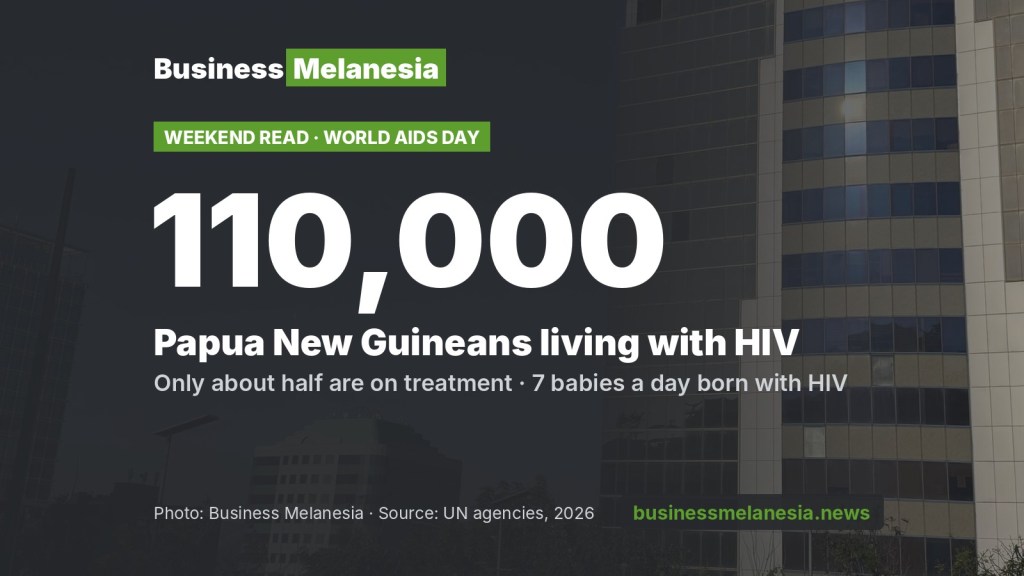
WEEKEND READ · WORLD AIDS DAY
110,000
Papua New Guineans living with HIV
Only about half are on treatment · 7 babies a day born with HIV
PORT MORESBY — Every day in Papua New Guinea, about 30 people learn they have HIV. Seven of them are newborn babies.
That is not a rumour from a Facebook page. It is the Government’s own count. When Health Minister Elias Kapavore declared a National HIV Crisis in June last year, he called the rise “deeply concerning”. Eighteen months later, the UN agencies working with PNG estimate that about 110,000 of our people are living with the virus, the biggest epidemic in the Pacific by far. New infections have doubled since 2010.
Behind the numbers is a story Papua New Guineans whisper about but rarely say out loud: money, poverty, power and silence.
Who is carrying it
This is no longer a disease of “other people”. Women now make up about six in every ten adults living with HIV in PNG. Only about one in four pregnant women with the virus receives treatment, so around 2,700 babies were born with HIV in 2024. With the right medicine during pregnancy, almost all of them would have been born free of it.
The National AIDS Council Secretariat has warned that girls and young women aged 15 to 24 are now the group most at risk of testing positive. It has been working with the Education Department to strengthen HIV and sexual health lessons for Grades 9 to 12, with a focus on girls.
The money and the poverty
Researchers have long described what drives this. PNG’s epidemic did not stay inside the sex trade. It spread into ordinary homes because commercial sex, “transactional” sex and multiple partners are all common at the same time. Transactional sex means sex in exchange for money, school fees, phone credit, a ride or a meal. Studies in the Highlands have recorded young women trading sex for school fees, because when jobs and services disappear, the body becomes the last thing a poor girl can sell.
On the other side of that exchange is usually an older man with cash: the salary earner, the businessman, the leader with a car and a wallet. Then the virus goes home to his wife, and from her to the baby.
The numbers among women who sell sex are frightening. A national study by the PNG Institute of Medical Research found HIV in about 15 per cent of female sex workers in Port Moresby, 12 per cent in Lae and nearly 20 per cent in Mount Hagen. Most first sold sex between the ages of 15 and 24. Some were still children: the researchers had to include girls who were being commercially and sexually exploited.
Let us be plain about that. A girl under 16 cannot consent. A man who pays a schoolgirl for sex is not a “client” or a “sugar daddy”. He is committing a serious crime under PNG law, and he is very likely spreading HIV.
The “big man” myth
There is a common story on the streets that men with money “cover themselves with drugs” and carry on as before. The truth matters here. HIV treatment works so well that a person who takes it every day and keeps the virus at undetectable levels does not pass HIV on through sex. Treatment is protection, for the man and for his partners.
The real danger is the man who never tests at all. Fewer than one in five young men in PNG have ever had an HIV test, according to a University of PNG study of national survey data. In the same study, about a third of the young men who had tested said they first had sex before they turned 15. Overall, about 4 in 10 Papua New Guineans with HIV do not even know they have it.
Our classrooms and campuses
Many parents, teachers and lecturers are worried about students, from high school to university and colleges. Those worries are real, and the risk factors above point straight at young people. But nobody has published reliable HIV figures for PNG’s universities or schools. Rumours fill that silence instead.
That is itself a failure. Our universities and colleges train the doctors, lawyers, engineers and leaders of the 2030s. We should know whether they are safe. Confidential, voluntary testing on every campus, with proper counselling, would replace gossip with facts and get young people onto treatment early.
What it means for the economy
Strip away the shame and HIV is a business and budget problem. It hits people in their most productive years: the 20- to 40-year-olds who drive trucks, guard sites, teach, nurse, run market stalls and fill company offices. Untreated HIV means sick days, lost skills, orphaned children and families pushed back into poverty. That poverty then feeds the next round of infections.
Then there is the bill. PNG pays for only about 30 per cent of its HIV response. Foreign donors pay the rest, and that money is shrinking. Every new infection means a lifetime of medicine. Last year Cabinet approved a K50 million emergency fund for HIV, TB and malaria, which was a welcome step. It is still a fraction of what a country of more than ten million people will need if infections keep doubling.
Our take
PNG beat back HIV once before, in the 2000s, when churches, government, business and communities talked about it openly. The virus came back when the talking stopped. Silence is the epidemic’s best friend.
We should not hunt down or shame people living with HIV. Shame is exactly what keeps people from testing. What we should go after is the behaviour and the system: men who buy sex from children, leaders who will not fund prevention, and a country that leaves its girls with nothing to trade but themselves.
The fixes are known and affordable. Every pregnant mother should be tested and treated, which alone could stop most of those seven babies a day. Testing should reach men and young people where they are: workplaces, campuses, markets and mine sites. Child sex offences should be prosecuted without fear or favour. Above all, girls need to stay in school and get real jobs, because the cheapest HIV prevention in PNG is a young woman with her own income.
Your money: prevention is the best-value spending in any health budget. With donors pulling back, Waigani’s HIV line deserves the same scrutiny as any road or power project. Employers can do their part today with workplace testing days and HIV-friendly policies. They cost little. Losing a trained worker costs far more.
What to watch: World AIDS Day on Tuesday, 1 December, and whether the Government sets firm new targets for testing men, protecting babies and putting confidential testing in schools and on campuses.
Get tested. It’s free and confidential. HIV testing and treatment are available at government health facilities across PNG. If a child is being sexually abused or exploited, report it to police or call the free 1-Tok Kaunselin Helpim Lain on 7150 8000.
Image: Business Melanesia.



Leave a Reply