
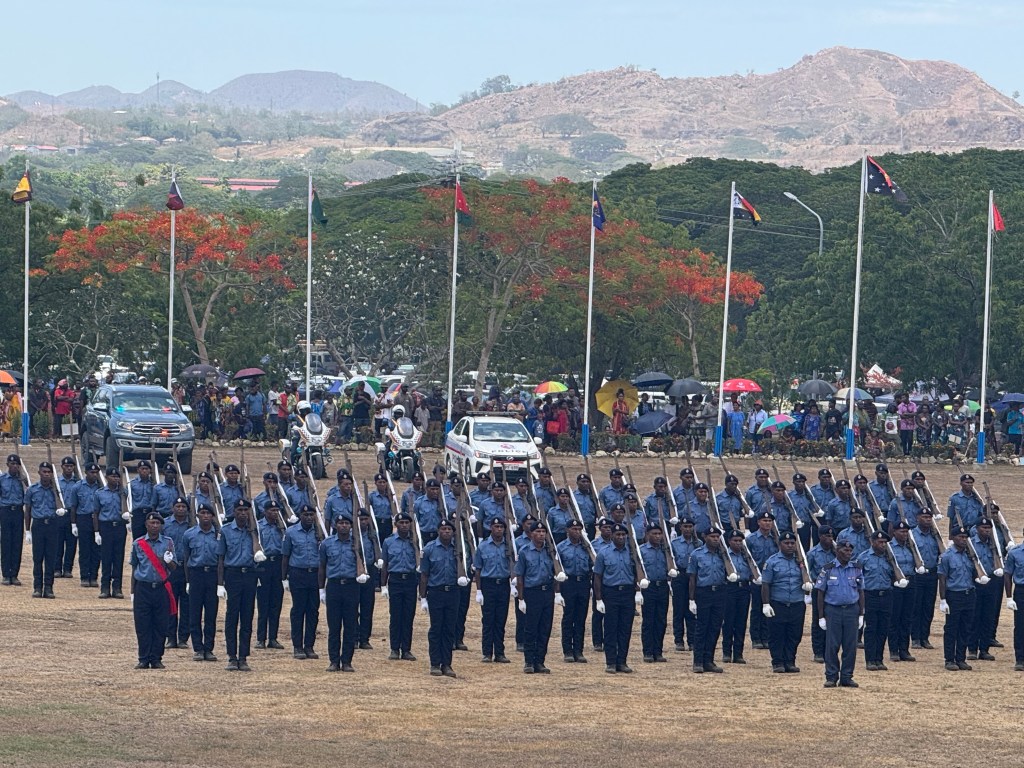
PORT MORESBY — The second half of Papua New Guinea’s biggest-ever police recruit class marched out at Bomana today, completing a week that put 653 new constables into the Royal Papua New Guinea Constabulary.
The Post-Courier reported that the force held its second pass-out parade at the National Centre of Excellence in Bomana today. It follows Tuesday’s parade, which Business Melanesia covered from the parade ground.
The numbers
According to the PNG Sun, 327 recruits — 290 men and 37 women — graduated on Tuesday, with the remaining 326 due today, for a total of 653, including 73 women. The paper described it as the largest successful recruit intake in the force’s history. The class began training in May, when the PNG Sun reported 662 recruits had been selected from more than 28,000 applicants.
The Government’s case
Deputy Prime Minister John Rosso, giving the keynote address, set out the Government’s plan, the PNG Sun reported. The force has about 7,500 members, and the target is 10,000 regular officers by 2030, with Bomana training 1,000 recruits a year. The Government has committed an extra K200 million to police infrastructure and equipment, including 400 vehicles towards a target of 800, as well as boats. Fifty-four officer cadets were commissioned in October to fill gaps in middle management.
Mr Rosso also spoke plainly about conduct. He said 65 officers had been dismissed this year, bringing dismissals under Commissioner David Manning’s leadership to about 700, and told the graduates: “Officers are expected to maintain high standards of integrity.”
Our take on the numbers
The Deputy PM’s own figures show both the progress and the scale of the gap. With about 7,500 officers for a population he put at 11 million, PNG has roughly one police officer for every 1,470 people, by our calculation. Reaching 10,000 would improve that to about one for every 1,100. But Mr Rosso noted that a United Nations benchmark would suggest 26,000 officers, which is about one for every 420 people.
There is also the question of attrition. Training 1,000 a year adds up quickly, but retirements, resignations and dismissals take officers out every year. Hitting 10,000 by 2030 means the force must grow faster than it loses people, while also housing, paying, equipping and supervising the new constables, especially in the provinces. The dismissals cut both ways: they show discipline is being enforced, and they show how much there is to enforce.
Why it matters
Law and order shapes almost every big decision in PNG. Businesses count security among their largest costs, investors in projects such as Papua LNG weigh it closely, the 2027 national election will need police at polling and counting centres nationwide, and from 2028 the PNG Chiefs are expected to bring regular crowds of visitors to Port Moresby. More trained, disciplined officers on the ground make all of that easier. Many leaders also link crime to youth unemployment, which means jobs and schooling remain part of the answer alongside policing.
What happens next
Watch for where the 653 new constables are posted, how many are assigned to election security and the provinces, how the K200 million is spent, and whether next year’s intake reaches the 1,000 the Government is promising.
Main photo: Tuesday’s first pass-out parade at Bomana. Photo: Business Melanesia.



Leave a Reply