
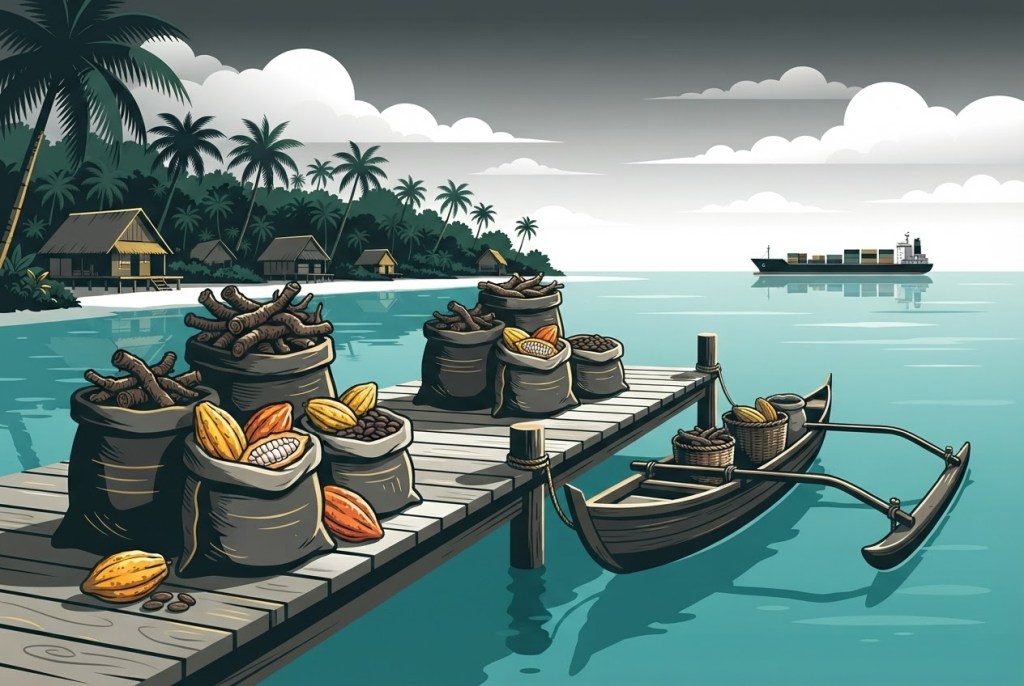
PORT VILA — Every week, a locally owned Vanuatu company pays farmers between VT20 million and VT25 million for their kava and cacao. That money lands in villages on Gaua, Maewo, Santo, Ambae, Pentecost, Malekula, Ambrym, Epi and Efate. The company is MT Kava Limited, and its rise is one of the quieter success stories in the Pacific.
According to Vanuatu’s Ministry of Trade and Commerce, MT Kava exported 103 tonnes of kava in 2025 and had already shipped 87 tonnes by June this year. It once sold mainly to Australia and the United States. Today its products go to Fiji, New Caledonia, Spain, India, China, New Zealand, Australia and the US.
From two lines to three
The turning point was investment in machines. With help from the government’s Industry Development Fund and Value Addition Fund, the company bought modern processing equipment and grew from two lines, kava and sandalwood, to three by adding cacao. It expects to export between 100 and 200 tonnes of cacao as production builds, starting with a first shipment to New Zealand.
It also tackled the hardest problem in island trade: getting the crop to the wharf. Using government support and its own reinvested earnings, it bought two Land Cruisers for Malekula and Pentecost and a banana boat for Ambae. Produce now moves weekly from farming communities to shipping ports.
Director of Industry Noel Kalo called the company an excellent example of what government backing can do, adding that businesses that receive support must commit to growing sustainably.
Why it worked
Three things stand out. The support was targeted at equipment and value-adding, not handed out as cash. The company diversified both its products and its buyers, so a bad season in one crop or market does not sink it. And it fixed logistics, the cost that kills most island exporters. A Pacific Trade Invest survey this year found Vanuatu’s exporters had the strongest growth momentum in the region, but also some of the toughest supply-chain problems.
The lesson for PNG
PNG grows kava, cocoa and spices across far more land than Vanuatu has. What it often lacks is the middle of the chain: the processor who buys reliably, adds value and owns the trucks and boats. MT Kava shows that a modest grant tied to machines and transport, matched by an owner reinvesting profits, can lift whole island economies. PNG’s agriculture agencies and lenders could do worse than study it. As our Huon Gulf cocoa story showed this week, the farmers are ready.
Know a business success story from PNG or the Pacific? Tell us at news@businessmelanesia.news.
Image: Illustration.




Leave a Reply