
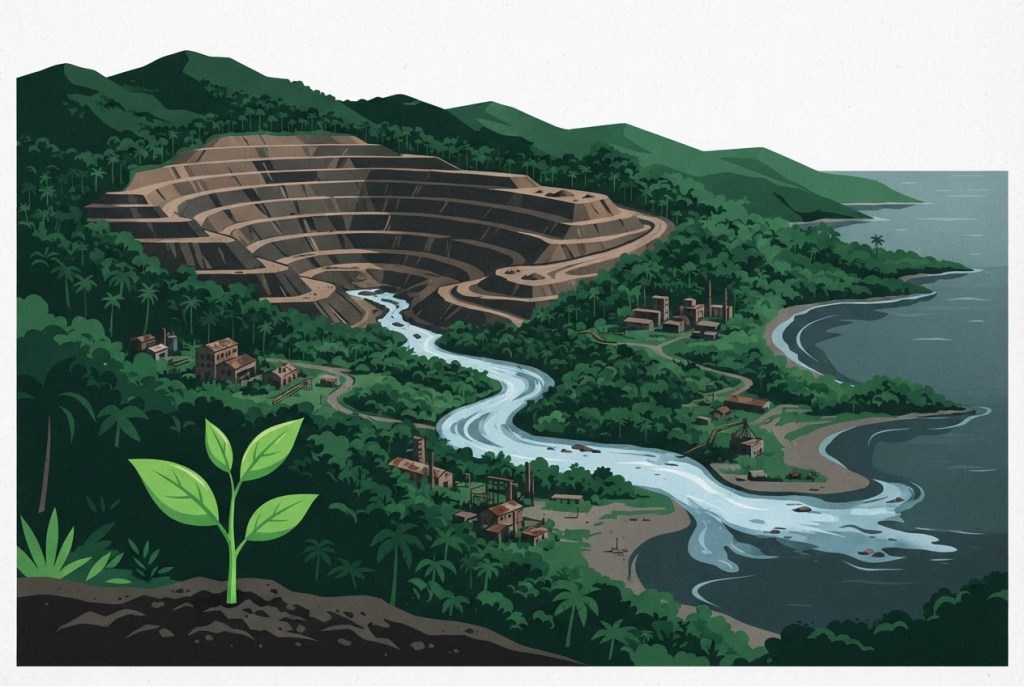
Buka — For more than three decades, families living below the Panguna mine have lived beside collapsing waste dumps, unstable levees and rivers stained by the old copper workings. Now, for the first time, the company that ran the mine has put serious money on the table to start fixing it.
Rio Tinto has agreed to contribute US$250 million (about K1.1 billion at current rates, or A$371 million) over the coming years to a new fund to address the environmental and human rights impacts of the former mine in Central Bougainville. The agreement was reached last week with Bougainville Copper Limited (BCL), the Autonomous Bougainville Government (ABG) and Panguna community leaders.
According to RNZ Pacific, the fund will pay for practical responses to problems identified by the independent Panguna Mine Legacy Impact Assessment, with a focus on the river and delta areas. It will be kept separate from any future plans to reopen the mine or port. Its structure, governance and priorities are still to be worked out with communities, the ABG, BCL and Rio Tinto.
The deal is the result of a human rights complaint lodged seven years ago by local communities, represented by the Australian-based Human Rights Law Centre. Rio Tinto agreed in 2021 to fund the impact assessment, which confirmed serious risks from landslides, levee failures, flooding and pollution.
Lead complainant and community leader Theonila Roka Matbob welcomed the commitment while being clear about its limits. “No amount of money will restore the damage,” she told RNZ, adding that the fund lays a foundation to tackle environmental problems and invest in children’s futures. She has said safe drinking water and bridges for access to schools, health care and markets are among the most urgent needs.
Rio Tinto’s chief safety and technical officer, Mark Davies, called the fund an “important milestone” in moving from assessment to practical remedy. Bougainville President Ishmael Toroama said the money would make a real difference to affected villages, and that ongoing engagement with communities would be essential.
Why it matters
Panguna was once one of the world’s most profitable copper and gold mines. It closed in 1989 amid protests over environmental damage and the sharing of profits, sparking a decade-long conflict in which an estimated 15,000 to 20,000 people died. The Guardian reports that Rio Tinto and other investors earned nearly US$2 billion from the mine, while less than one per cent of profits reached Bougainvilleans. Rio Tinto exited in 2016, transferring its shares to the PNG and Bougainville governments.
Dealing with the mine’s legacy matters well beyond Panguna. Many on Bougainville, including the President, see a future restart of the mine — believed to hold large untapped reserves — as the financial foundation for the island’s political future. Investors watching PNG’s resources sector will also note a major miner accepting responsibility for legacy damage decades after closure.
What happens next
Community consultations will now set the fund’s priorities and how it is governed. The Human Rights Law Centre has urged that the commitment be turned into action quickly, and the Guardian notes US$250 million will not be enough to fully rehabilitate the site. Meanwhile, the National Parliament is still to decide whether to ratify the 2019 Bougainville referendum, and President Toroama has said Bougainville intends to move to self-government from September next year.
Image: Illustration.




Leave a Reply