
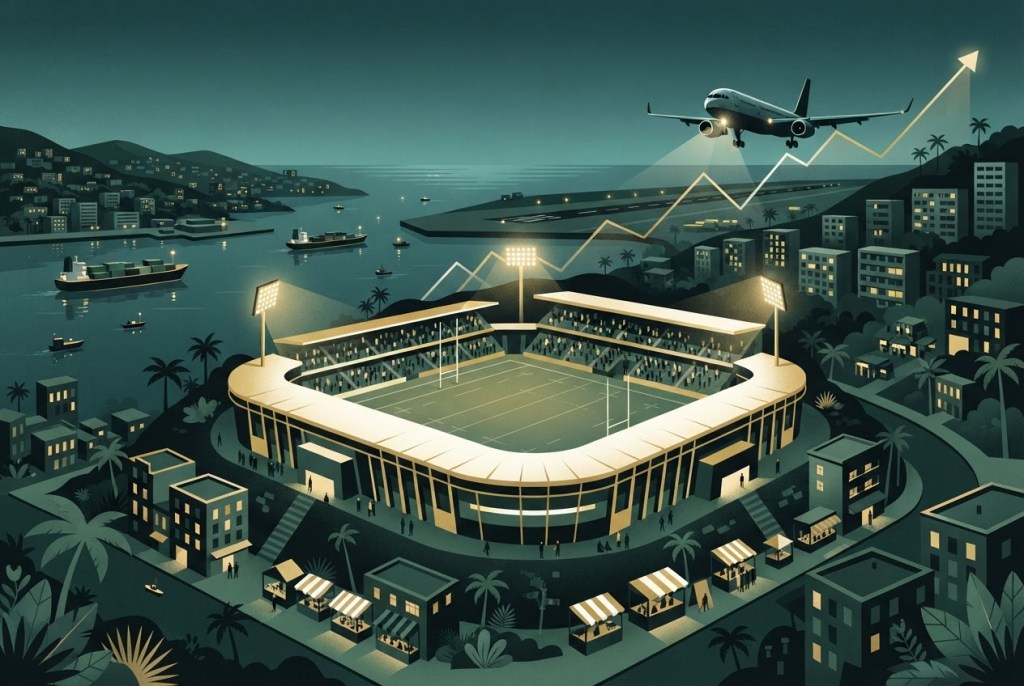
Port Moresby — In a little over a year, Papua New Guinea will field a team in the world’s richest rugby league competition. The signings keep coming: NSW Origin forward Hudson Young became the ninth this week, as we reported. The argument over whether the PNG Chiefs are worth it has grown louder alongside them.
Prime Minister James Marape calls the club a national unity and economic transformation project. Former Prime Minister Peter O’Neill and other critics call it a distraction. Both cannot be entirely right. Here is what the record shows.
The deal in numbers
- A$600 million over 10 years from the Australian Government, announced in December 2024. The ABC reported the original split as A$290 million for the franchise, A$250 million for rugby league partnerships across the Pacific and a A$60 million NRL licence fee.
- About 5,000 jobs expected from the investment, according to Charlotte Blundell of Australia’s Department of Foreign Affairs and Trade, along with social programmes on gender equality, violence and health, AAP reported.
- A$120 million pathway programme to build grassroots talent in PNG and across the Pacific, according to the same AAP report.
- K200 million players’ village at Airways, built by the Constantino Group, with 67 of its 80 units for the Chiefs, NBC News reported in March.
- Tax-free salaries for players and staff under arrangements between the two governments, the club’s main recruiting edge.
The economic case
The strongest point in the Chiefs’ favour is who pays. Most of the money is Australian, so PNG gets a professional sports franchise without carrying most of the cost on its own budget. The tax exemption is often counted as a loss to PNG, but it is worth asking what is actually given up. Salaries on this scale would not exist in Port Moresby without the club, so most of that tax was never PNG’s to collect. What PNG does gain is the spending around those salaries: rent, staff, security, transport, food and services bought locally.
Then there is the market. Sport economist Professor Tim Harcourt told the ABC that, unlike NRL or AFL expansion into new Australian cities, PNG offers a “ready-made audience”. Rugby league is the national game, which gives sponsors and broadcasters a mass audience from the first match. AAP reported that the Chiefs’ first jersey is tipped to be worth about A$20 million in sponsorship.
Tourism: the biggest upside, and the biggest test
Mr Marape has said Port Moresby must be ready for 3,000 to 5,000 visitors every second week from 2028. The scale of that becomes clear against the baseline. The PNG Tourism Promotion Authority’s sector plan puts international arrivals at roughly 100,000 to 200,000 a year, supporting about 16,000 jobs and around K122 million in tax revenue.
An NRL season gives a club about a dozen home games. If the Prime Minister’s estimate holds, that is somewhere between 36,000 and 60,000 visitor trips a year. That would be a significant addition to PNG’s current tourism numbers, concentrated in the capital and on airlines, hotels, transport operators, caterers and market sellers. The constraints are just as real. The National Football Stadium holds only about 15,000 people, and the club has said it is looking at expanding it. Hotel capacity, flights and above all safety will decide whether visitors come once or keep coming.
Diplomacy and politics
The Chiefs are also a foreign-policy instrument, and both governments know it. The ABC has reported an understanding that Australian funding can be withdrawn if PNG signs a security pact with China. Australia has also said no funding is guaranteed after 10 years. Supporters see a club woven into the Australia–PNG relationship, giving PNG leverage and a stronger profile with its largest partner. Critics see a sovereignty cost. Mr Marape has said the China pledge is not the main feature of the deal.
At home the politics are sharper. Mr O’Neill, the Ialibu-Pangia MP, called the tax-free incentives “outrageous” and said it was wrong for the team to depend on Australian taxpayers, NBC News reported in May. Mr Marape denied his claims and said the club’s roles are set under bilateral agreements. Opponents have also accused the Prime Minister of offering “bread and circuses” instead of tackling domestic problems, according to the ABC. Mr Marape has called such critics “shallow-minded” and says government work on health, education and infrastructure continues.
Youth: the long game
The most lasting return may come off the field. Mr Marape has made school attendance a condition of the dream: to wear a Chiefs jersey, young people must stay in school, NRL officials have said. DFAT’s Ms Blundell said youth engagement is a central aim because employment is weak, and described the club as offering young Papua New Guineans “a pathway, a goal, and a reason to believe”. If the pathway programme produces professional players, coaches, trainers and sports administrators, the payoff will long outlast any signing.
The doubts deserve an answer
Public opinion is genuinely divided. In a 2025 survey of almost 400 University of PNG business and public policy students, published by the Development Policy Centre, 42 per cent supported the NRL team and 47 per cent opposed it. Seventy-one per cent said the A$600 million could be better spent on more pressing needs, and female students were markedly more sceptical than male students. In Australia, coaches such as Wayne Bennett argue the tax-free pay gives the Chiefs an unfair recruiting edge, and analysts have raised security, corruption and violence as risks the club must manage.
Why it matters
The economic case for the Chiefs is real but conditional. The franchise brings outside money, a brand that reaches every province, and a reason for thousands of visitors to come to PNG regularly. None of it is automatic. The benefits depend on decisions PNG controls: making the capital safe and welcoming for visitors, opening contracts and supply chains to local businesses, keeping ticket prices within reach of ordinary fans, and making sure the youth and social programmes reach the provinces and not just Port Moresby. They also depend on building a club that can stand on its own commercially before the Australian funding runs out.
What happens next
Watch for the stadium expansion plan, the remaining marquee signings, details of how the pathway and social programmes will be delivered outside the capital, and any independent economic impact study. That kind of evidence would settle the argument better than either side’s rhetoric. Business Melanesia will track the Chiefs’ recruitment, spending and preparations every week until kick-off in 2028.
Image: Illustration.





Leave a Reply